
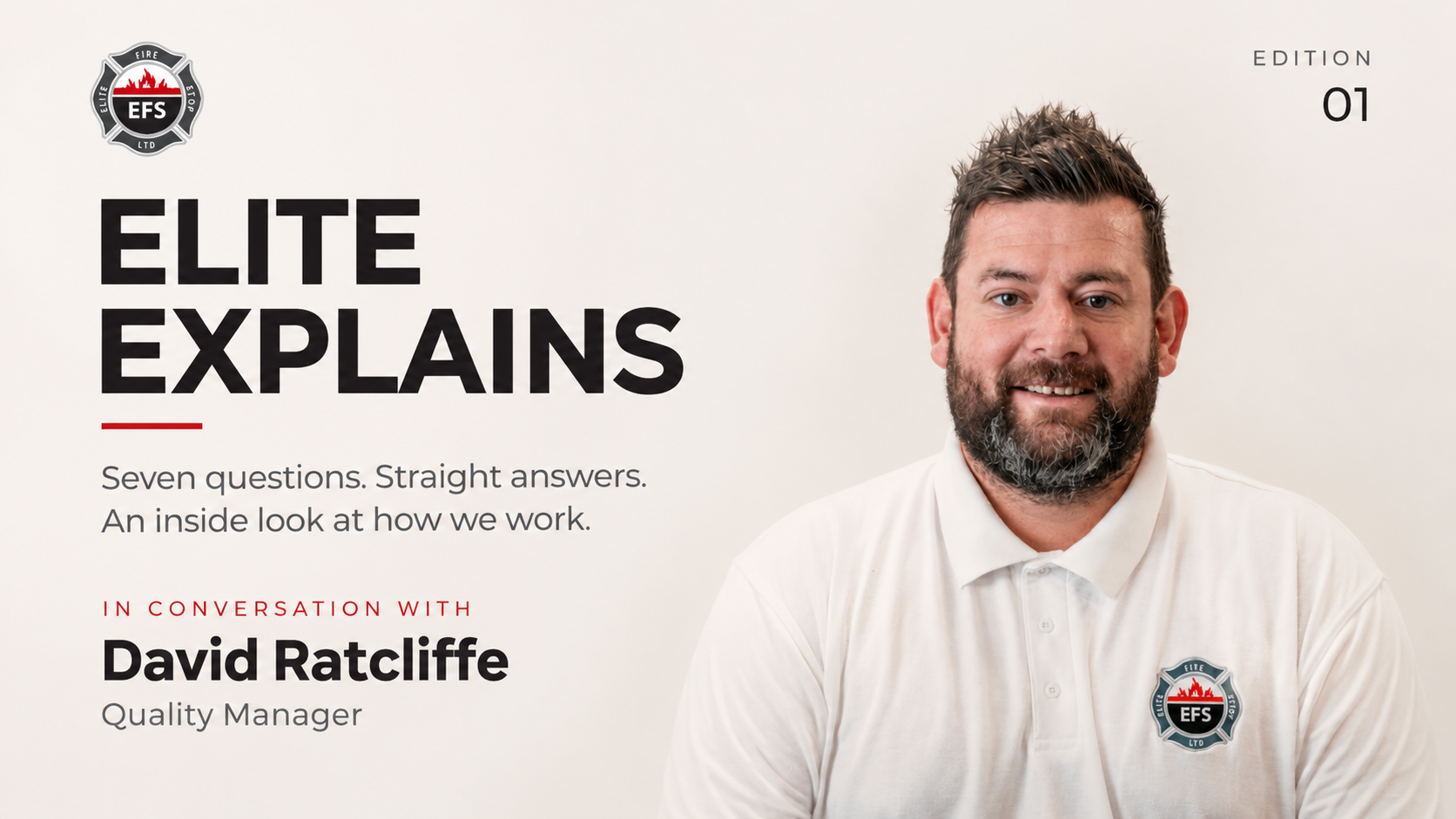
What Does a Quality Manager Do in Passive Fire Protection?
Elite Explains with David Ratcliffe
Passive fire protection plays a vital role in helping prevent fire and smoke from spreading through a building. The quality of every installation matters, from the specification and tested detail through to the final inspection and sign-off.
In the first edition of Elite Explains, we speak to David Ratcliffe, Quality Manager at Elite Fire Stop, about the importance of getting firestopping right, the challenges encountered on site and the quality assurance processes that help protect lives.
What's the most common quality issue you see with passive fire protection on site?
Internally, it's working to the specific detail that is in place for that specific service. Including the substrate build up and EI ratings. Externally it is getting other contractors and clients to buy into the specific build up of substrates and M&E requirements for the tested solutions.
What happens if the site condition doesn't match the tested detail?
If the site conditions don't match the tested detail, we raise this with the site team and explain what needs to change. Depending on the issue, adjustments may be needed before we can proceed with a compliant installation.
Why can't the same firestopping detail be used everywhere?
Tested firestopping details are specific to the services passing through an opening and the construction of the wall or floor. For example, a detail tested for a copper pipe passing through a double-skinned flexible wall may not be suitable for the same pipe in a single-skinned flexible wall. This is why the selected detail must match the actual site conditions.
What does a good QA process actually look like?
A good QA process starts before the installation, with checks to confirm the specification, installation details and materials are correct, and that the installer is competent to carry out the work. The installation should then be completed in line with those requirements, checked by the installer, and clearly photographed and recorded within the digital system. A final review of the work and supporting records should take place before sign-off, providing a clear record of what has been installed, how it has been checked and who has approved it.
What's one thing other trades could do to help us get firestopping right first time?
Engage with us early to understand what the tested firestopping detail requires. The wall or floor build-up and the arrangement of mechanical and electrical services need to meet those requirements for us to complete a compliant installation. Getting these details right from the outset helps avoid rework and, most importantly, protects lives.
Why are photos and installation records so important?
Photos and installation records provide evidence of how the work has been completed and checked against the specified requirements. They capture details that may no longer be visible once the work is finished, support the identification and resolution of defects, and give the client a clear, traceable record of the installation and its sign-off.
Is there anything you regularly see on site that you think people need to understand better?
One thing we regularly see is installation details not being followed correctly. People need to understand that these details matter, something that appears minor can affect how the system performs in a fire. Getting the installation right is about protecting people, and the consequences of getting it wrong could cost lives.